
Seamless Implementation
Generation Faraday Guides You Every Step of The Way
With an ever-growing product line and focus on innovation, Generation Faraday delivers tailored solutions for every school.
A Step-by-Step Guide to a Seamless Rollout
Implementation Phases
Our five-step plan ensures a smooth rollout, guiding administrators, teachers, parents, and students toward a distraction-free learning environment.
01.
Information Gathering
Schools first determine whether to use locking or non-locking Faraday bags, set a roll out schedule, and review available resources. Understanding the product, app, and overall implementation process is key before moving forward.
02.
Planning
Administrators review recommended policies and complete the policy quiz to define how phone use will be managed, determine the number of Unlock Docks and Handheld Keys needed, and set the replacement policy for students. A replacement policy (such as a $40 replacement fee) is necessary to deter deliberate tampering with the bags. This phase ensures the school’s policy aligns with practical implementation and daily operations.
03.
Training
Administrators review recommended policies and complete the policy quiz to define how phone use will be managed, determine the number of Unlock Docks and Handheld Keys needed, and set the replacement policy for students. A replacement policy (such as a $40 replacement fee) is necessary to deter deliberate tampering with the bags. This phase ensures the school’s policy aligns with practical implementation and daily operations.
04.
Launch (+ App Rollout)
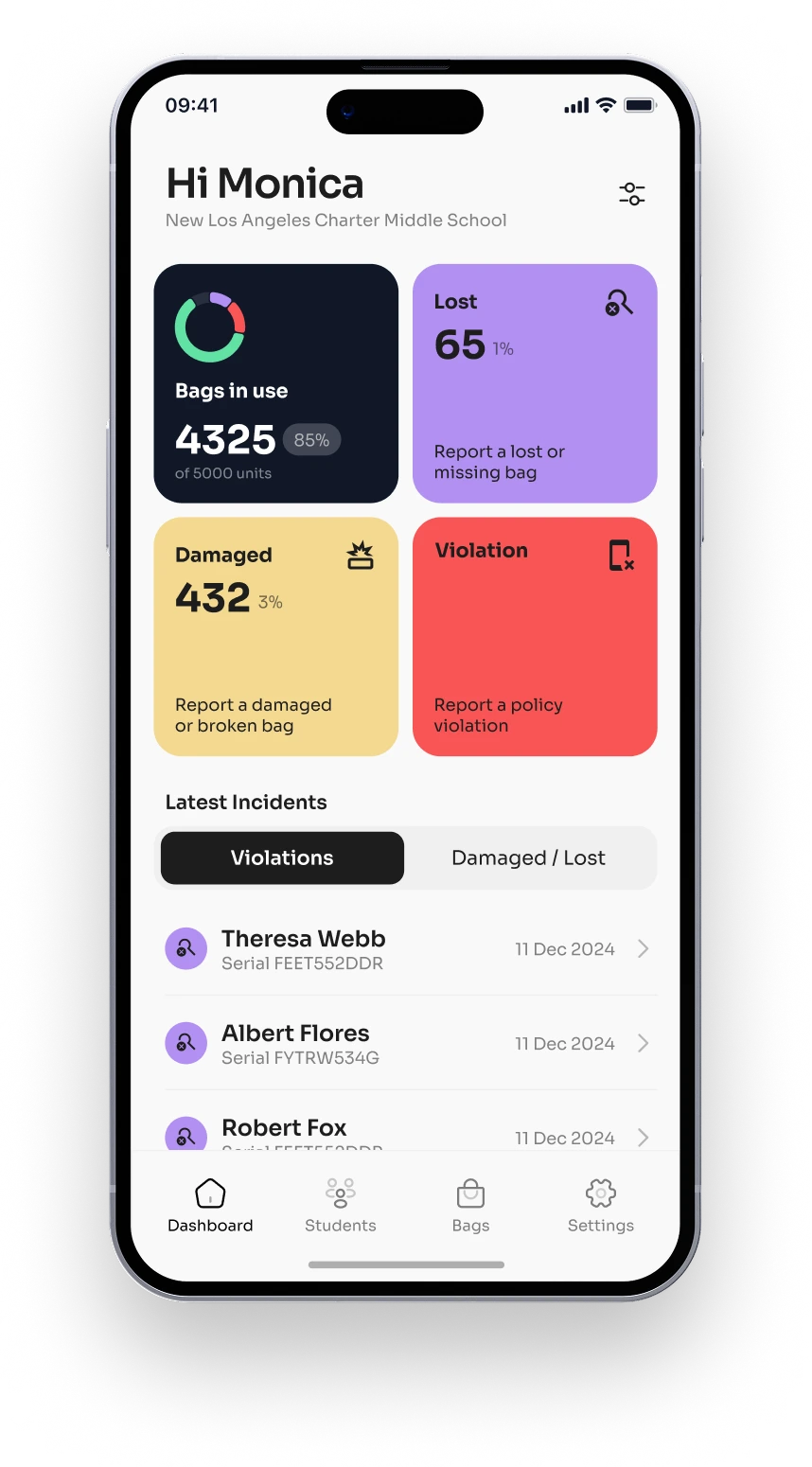
Unlock Docks are installed, and each student is assigned a Faraday bag with a unique serial number, which is logged in a tracking spreadsheet. Schools submit this data to Generation Faraday for integration into the management app, and students receive their assigned bags to begin daily use.
05.
Daily Use and Ongoing Support
Students use their assigned Faraday bags daily, locking and unlocking them per school policy. Schools can track compliance and manage assigned bags through the Generation Faraday app, ensuring accountability and easy asset tracking. Ongoing support is available for troubleshooting, training, and replacements.
TEsted and PRoven
Recommended Policies
Policies vary based on each school’s specific campus.
The following three policies are the most common implementations of Generation Faraday:
RECOMMENDED
Bell-to-Bell
Student Assigned Bags
Each student has an assigned bag they bring daily. Bags are locked at the first bell and unlocked at the end of the school day.
Benefits
Drawbacks
MOST CENTRALIZED
Bell-to-Bell
No Bag Assignment
Students receive a bag upon entering campus and return it to a collection bin at the end of the day.
Benefits
Drawbacks
MOST FLEXIBLE
Phone-Free Instructional Time
Students lock phones during class only. Use is allowed during breaks and lunch. Assigned bags are still used.
Benefits
Drawbacks
GENERATION FARADAY APP